
NCEC — National Center for Environmental Compliance
NCEC: Saudi Arabia's National Environmental Performance Platform
A central national platform unifying environmental data from 15+ Saudi sectors — replacing fragmented, manual collection with API-integrated KPI tracking, dynamic reporting, and decision-ready analytics for institutional leaders.
The Challenge
The National Center for Environmental Compliance faced a deeply fragmented data landscape. Environmental performance data arrived from different organizations in different formats, with no central system to collect or standardize it. The entire process of gathering, processing, and analyzing data was manual and redundant — consuming significant time while producing outputs that were hard to act on. There was no structured way to calculate or visualize KPIs at either the national or sector level, leaving institutional leaders without the analytical tools needed for strategic environmental decision-making.
The Solution
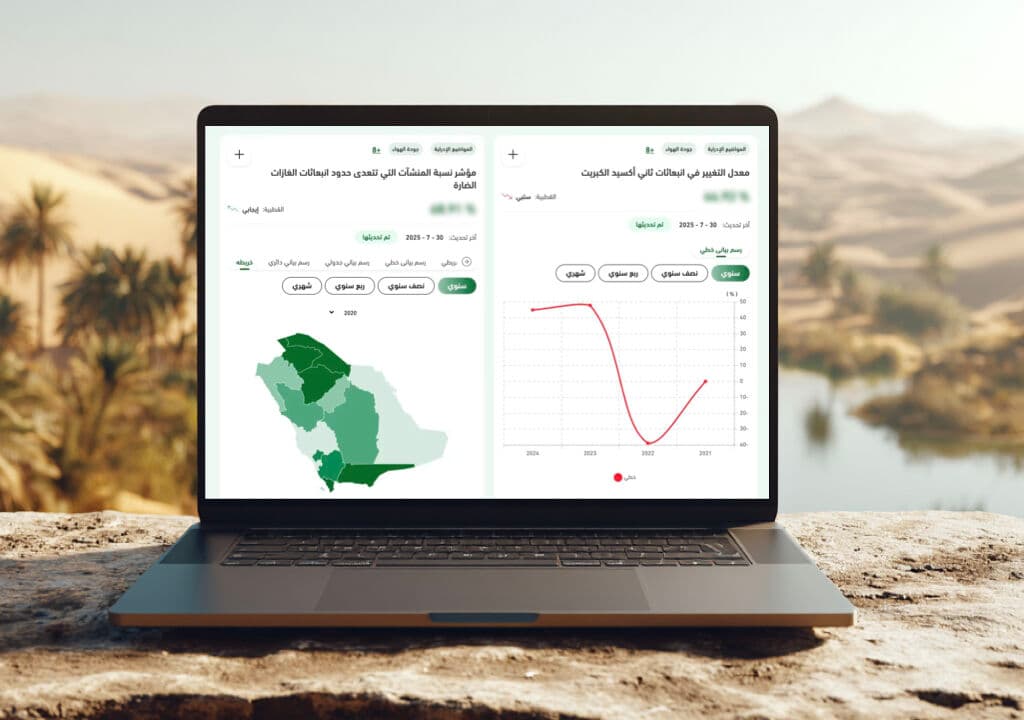
RTG, engaged through Palladium, approached this as a platform architecture challenge — not just a reporting tool. Beginning in early 2024, the team conducted market benchmarks across analytical platforms in comparable fields to understand how leading systems operate. The result was a modular, MVP-first platform designed to grow incrementally: starting with core data ingestion and progressing to full KPI analysis and reporting. Organizations can submit environmental data via direct file upload or through API integration, removing the dependency on manual processes. A KPI builder allows users to define custom indicators and equations. Dataset dimensions are configurable to support both sector-level and national-level measurement. Dynamic charts bring KPI data to life for decision-makers. The system also supports the creation of periodic reports and full annual reports, built directly on the KPIs it tracks.
The Process
Market Benchmarking & Discovery
The team began by researching how analytical and environmental performance platforms operate across comparable markets. User interviews with actual stakeholders were used to map real pain points — a critical step in a GovTech context where user needs are often underspecified.
MVP-First Architecture
RTG designed the platform with a deliberate phased approach — launching a working MVP and then incrementally expanding. This reduced delivery risk and allowed stakeholder feedback to shape subsequent features without compromising core functionality.
Dual Data Ingestion
To eliminate the manual bottleneck, RTG built two parallel data pathways: direct file upload to the platform for organizations without technical infrastructure, and API integration for those capable of automated data sharing. Both pathways feed into the same centralized dataset.
KPI Builder & Equation Engine
The platform allows users to create custom datasets, define dimensions, and build KPI equations — giving NCEC the flexibility to measure environmental performance at both the sector and national level, with indicators that evolve as policy priorities change.
Analytics, Charts & Reporting
Dynamic visualization charts bring KPI data to life for institutional leaders. The reporting module supports both sector-specific and cross-sector reports, with annual reporting capabilities built directly on live KPI data — enabling evidence-based decision-making at scale.
Conclusion
The NCEC platform represents what it means to build for national environmental governance at scale. By starting with a deep understanding of the data fragmentation problem — and designing a system flexible enough to serve both technically sophisticated organizations and those relying on manual upload — RTG delivered a foundation that can grow as Saudi Arabia's environmental compliance requirements evolve. The platform is currently in active UAT with stakeholder workshops underway, with full live deployment on the horizon.

